“Foundation Style Dog Training combines insights from welfare science, ethology, behavioral science, and innovative training mechanics to create technical, scalable, and humane behavior plans and training instructions for any dog and any purpose.”
— K9-1 Specialized Dog Training, dogtraining.world
At Reality K9, we practice Foundation Style Dog Training. This method was developed by world-renowned trainer Michael D’Abruzzo of K9-1 Specialized Dog Training. In this method, concepts build off one another to form a comprehensive training plan that addresses the entire dog. This allows us to help severe aggression cases and teach high quality off-leash obedience. The method prioritizes scientific integrity and ethically sound training practices that recognize the value of both positive reinforcement and properly introduced aversives.
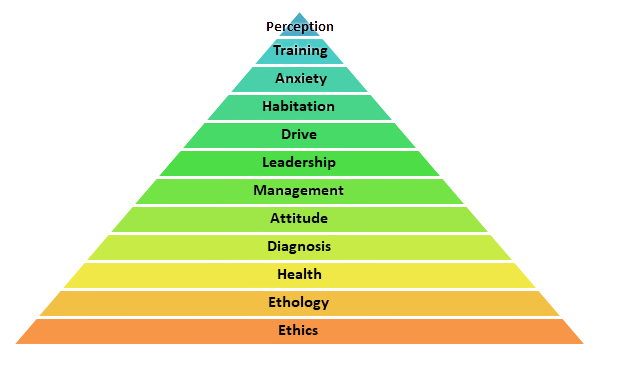
No level can be fully addressed until the foundational level below it has been addressed. Each step culminates in improving the dog’s perception of his reality.
Training is broken up into three phases
Phase one
The dog is taught what commands mean in a distraction-free environment. We first teach the command by having the dog follow treats, and then ensure he understands the true meaning of just the verbal cue by fading away any physical prompting we are doing. Once the dog is responding to just our verbal command, we begin thinning out the reward schedule and teaching the dog that remaining in the command keeps good things coming. In this phase, the only consequence for breaking a command is that treats and praise stop. This is because it has been proven that dogs learn new behaviors best through positive reinforcement, so it is important that aversives (training collars) not be used in this phase.
Phase Two
Still in a controlled environment, we show the dog what a correction is, how to escape it, and how to avoid it. Corrections are necessary in dog training because positive punishment is the only way to stop highly-motivated behaviors. Simply withdrawing treats as a consequence (technically a negative punishment) would not be enough to stop a dog from chasing a squirrel, for example. This is why, for truly reliable obedience, we must use both rewards AND corrections.
In this phase, we typically use a Starmark collar (plastic prong collar) and will apply gentle leash PUMPS that are designed to be irritating to the dog. There is NO harsh jerking, yanking, or popping.
We show the dog how to escape the correction by teaching him that he can “turn off” the leash pumps by returning to the command he just broke. This is a crucial first step that many trainers unfortunately skip. If a dog is not first taught how to turn a correction off, he could go into Learned Helplessness and shut down.
Once the dog understands how to escape a correction, we teach him the meaning of the word “no” by pairing it with the correction. We then show him how to avoid punishment altogether by making him see that disobedience leads to corrections and obedience leads to really fun things like treats, praise, and play.
Phase three
We bring things into the real world. At this point (and only at this point!) do we introduce the e-collar. We again show the dog how to “turn off” the correction of the new stim sensation at a very low level. We then introduce more motivational distractions that require more motivational corrections. With the e-collar, we can teach the dog that ignoring a correction causes the correction to escalate, until the dog finally reaches his avoidance level. This is far more humane and LIMA, as instead of perpetually needing to correct the dog on a lower level, the dog receives one or two high level corrections and then avoids the disobedience altogether. Off-leash obedience is achieved around high distractions, and we generalize this obedience to the scenarios and places the dog most often encounters.